
In the wake of FTX’s collapse four years ago, crypto exchanges rushed to calm jittery customers by publishing proofs-of-reserves: dashboards that purportedly showed the exchanges were solvent.
Tether, facing unrelenting criticism over its failure to secure a proper audit, long took a similar approach to assuage holders of its stablecoin, USDT.
FTX was a fraud, Tether was not. But the point remains: crypto is largely unregulated, and that makes customers nervous. A proof-of-reserve report has become companies’ go-to solution.
The problem is, many are deeply flawed. They are often lacking important information. They are often misleading.
DefiLlama is rolling out a new product, Verified by DefiLlama. It’s our attempt at addressing some of these issues. And it starts with Frax Finance.
Proof-of-reserve blues
After FTX failed, it scrambled to furnish proof that it was solvent. But it eventually abandoned the effort, citing “concerns regarding the way these reports are understood by the public.” Of course, we now know the firm was deeply in the red and any “proof” of reserves would have been yet another attempt at misdirection from disgraced CEO Sam Bankman-Fried.
Still, a US regulator issued a statement warning customers against putting too much trust in proof-of-reserve statements. That regulator, the PCAOB, said that customers should “exercise extreme caution,” that these engagements “are not audits,” that they described assets “at one point in time,” and that they “likely do not address the crypto entity’s liabilities.”
In the years since, exchanges and stablecoin issuers have presented proofs-of-reserves that operate in real-time, something that’s only possible due to crypto technology: backing assets held onchain can be observed continuously. There’s no need to ask Binance to open its books; they’re right there, for the entire world to see.
Llama verification
The problem is, many crypto companies hold assets offchain. This is especially true of stablecoin issuers, which often back their tokens with a mix of assets, such as other stablecoins and US Treasury bills.
Verified by DefiLlama is our attempt at addressing this gap. It launched on Nov. 2, with Frax as the inaugural partner.
Frax issues a stablecoin called frxUSD. About 98% of its reserves are held onchain across six Ethereum wallets.

But some of its assets are held offchain. Just over $2 million is held at Erebor, the tech-forward bank recently launched by Anduril founder Palmer Luckey.
How do we verify this? Frax gave us read-only access to banks, custodians, and fund administrators. We then check those balances at the source against the frxUSD token supply.
Frax is our first partner, but it won’t be the last. As we add exchanges and stablecoin issuers to this product, we’ll be sure to keep them honest. If a one misses an update, its label will be labeled “Stale.” If a figure cannot be independently checked, the exchange or issuer will be labeled “Unverified.”
To learn more about this new service, read our latest Spotlight report here, or visit defillama.com/verified.
→ LATEST FROM DEFILLAMA RESEARCH


→ DEEP CUTS
Variational, revisited
When Variational launched Swaps on September 1, our spotlight framed the product as a question of who sets your costs: a dealer-quoted carry rate you can book in advance, set against the variable funding on a perp.
Since then, Variational’s derivatives volume has climbed from $29.7B in August to $59.1B in September and $77.8B in October, with a peak day of $4.47B on October 6. It has cooled slightly, with weekly volume falling from $19.9B in mid-October to $14.4B at the start of November.
The mix is more diverse now, too: RWA open interest is $826.6M across 130 markets, up from about $710M and 119; Equity indices now hold $234M of open interest and $35.0B of 30-day volume; and Nasdaq-100 has overtaken gold as Variational’s largest market.

→ FIELD NOTES
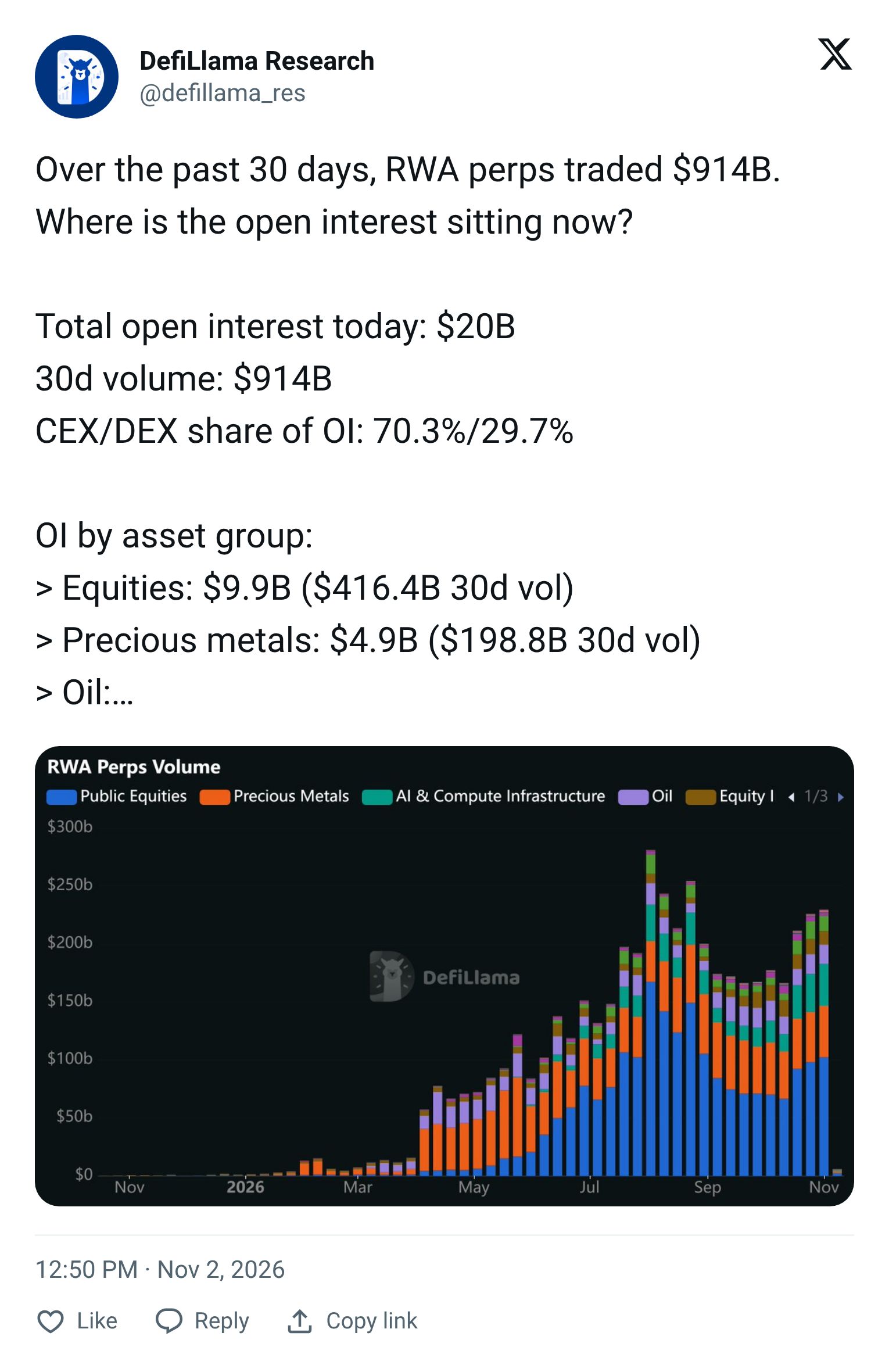
October RWA perp trading data
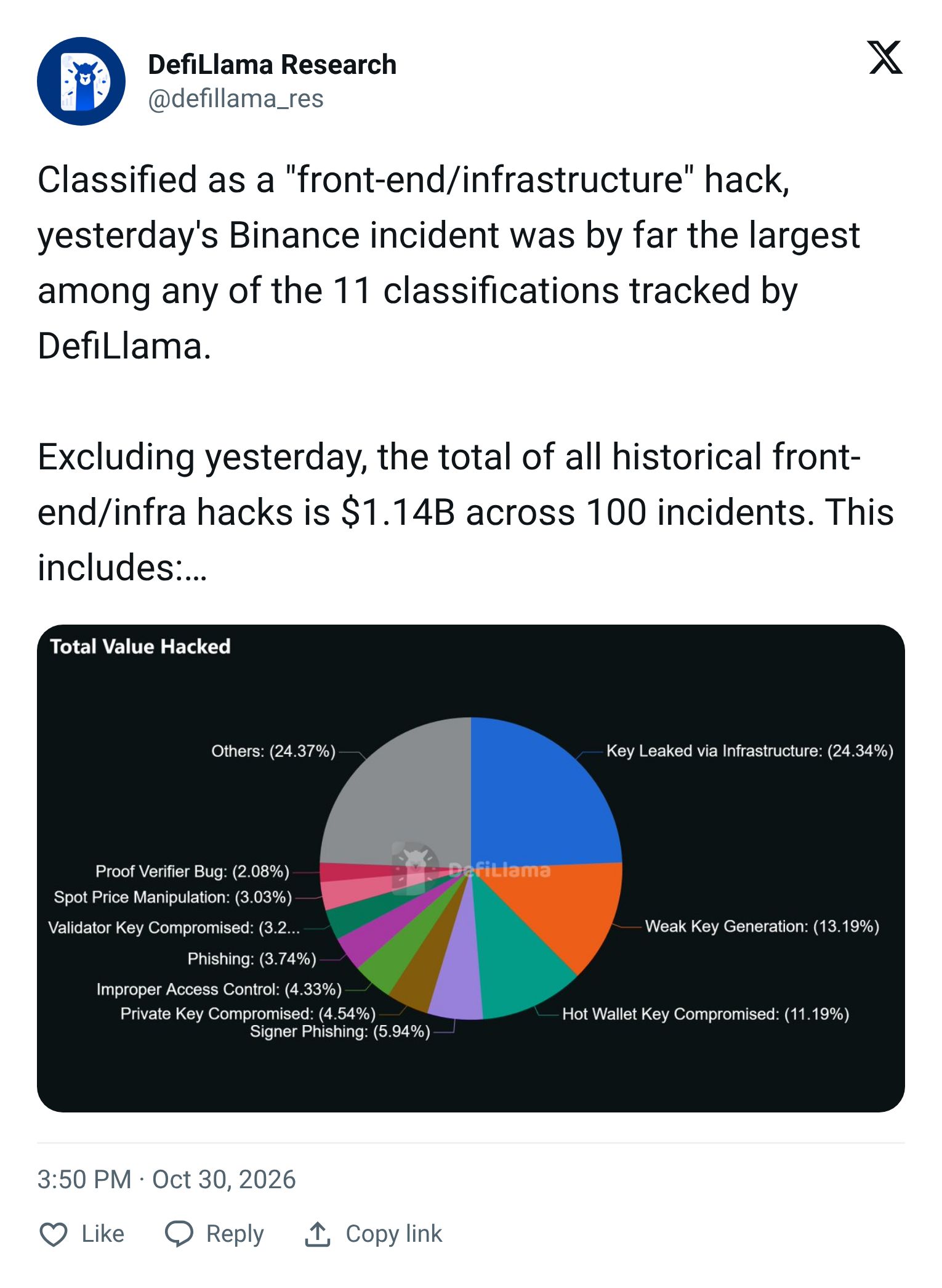
Front-end & infra hacks total ~$28B
→ WEEKLY NEWS ROUNDUP
Join the DefiLlama Telegram channel to see the full weekly roundup.
NEWS
LAYER 1 & 2
DEFI
READS
RAISES & ACQUISITIONS
SECURITY
AI
→ TOOLS FOR LLAMAS
Compare yield pools, side-by-side
Say you’re set on depositing into one of the biggest stablecoin pools. You put it next to another large pool on DefiLlama’s new yield comparison, and the table shows that one has a withdrawal queue, or that its top 10 holders own most of the pool. It’s a quick check, and it might change your pick.
You can now compare up to five yield pools side by side. The table shows APY split into base and reward yield, 30-day stability, TVL growth, holder count, exit status, top 10 holder concentration, rankings, and more.
🦙 Llama tip: To find pools worth comparing, try Yield Discover, which shows what’s growing fast, newly listed, trending, or just started paying rewards.

